Academic Program Assessment
What is Assessment?
In higher education, the term assessment can mean many things. Faculty regularly assess individual students through exams, papers, projects, performances, portfolios, theses, and dissertations. However, in the context of institutional improvement, assessment refers to the systematic collection and analysis of aggregated student learning data to answer a central question:
Are students learning what we expect them to learn?
At the University of Arkansas, assessment focuses on academic program-level outcomes, not on evaluating individual students or individual courses, although course-level work often contributes evidence to program assessment. Program assessment provides faculty and administrators with objective information about how well a program supports student learning.
Purpose of Assessment
The primary purpose of assessment is continuous improvement of student learning and instruction. It creates structured opportunities for faculty to reflect on curriculum effectiveness—identifying what is working well, where challenges exist, and how programs can better support student success.
A Collaborative, Improvement-Focused Process
Assessment is a collaborative effort grounded in improvement, not evaluation of individual faculty performance. It is not intended to demonstrate perfection or assign blame. All faculty contributing to a degree or certificate program are expected to participate in the assessment process in partnership with their department and dean’s office.
What This Page Covers
This page provides an overview of the university’s assessment reporting process. It explains how assessment plans are developed, outlines the steps programs must follow to meet institutional policies and accreditation expectations, summarizes reporting timelines, and clarifies roles and responsibilities.
We Care About Student Success
Assessment ensures that graduates gain the knowledge and skills needed for success after completing a program. Reviewing learning outcomes helps identify effective teaching strategies and areas for improvement, supporting continuous enhancement of student learning.
Assessment is University Policy
Student learning outcomes assessment is a university responsibility and priority. Academic Policy 1630.10 establishes expectations for assessment and the use of results for planning and improvement.
Assessment is Required for Accreditation
Academic program assessment is required by the University of Arkansas’ accrediting body, The Higher Learning Commission (HLC).
HLC Criterion 3, Teaching and Learning for Student Success states:
The institution demonstrates responsibility for the quality of its educational programs, learning environments and support services, and it evaluates their effectiveness in fulfilling its mission. The rigor and quality of each educational program is consistent regardless of modality, location or other differentiating factors.
Criterion 3.E. and 3.G. further state:
The institution improves the quality of educational programs based on its assessment of student learning.
The institution’s student success outcomes demonstrate continuous improvement, taking into account the student populations it serves and benchmarks that reference peer institutions.
Every degree and certificate program at the U of A is expected to:
- Define clear student learning outcomes
- Identify appropriate assessment measures
- Evaluate student performance
- Analyze and use results for program improvement
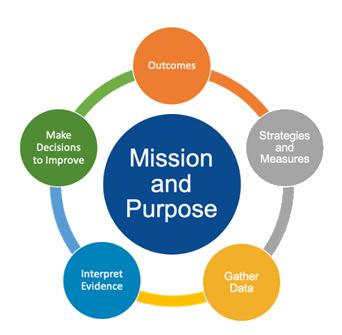
Program faculty within each college lead assessment efforts because they hold disciplinary expertise. The collection of outcomes, measures, criteria, and methods forms the program’s assessment plan.
An assessment plan outlines a systematic approach to reviewing student learning within a program. At its core, it answers four key questions:
- What are students expected to learn?
- Where in the curriculum do students learn and apply these outcomes?
- How do faculty know students are achieving the outcomes (evidence)?
- So What actions will be taken based on the findings?
Assessment plans should include:
- Clearly defined, measurable learning outcomes
- Direct alignment between outcomes and assessment measures
- Measures independent of course grades or teaching evaluations
- Multiple measures, including at least one direct measure
- Longitudinal and cyclical data review
- Findings that inform program decisions
- Documented actions taken in response to findings
For additional information on student learning outcomes and assessment, visit the Wally Cordes Teaching and Faculty Support Center Teaching Resources webpage.
See the U of A Assessment Plan Template.
Although often referenced together, assessment plans and assessment reports differ slightly in scope. Annual assessment reports demonstrate how programs evaluate the success of their learning outcomes and use evidence to improve curriculum and instruction.
Assessment Plan Components
- Program Goals and Objectives
- Program Learning Outcomes
- Methods
- Measures and Criteria
Assessment Report Components
All assessment plan sections plus:
- Results
- Use of Results
See the U of A Assessment Report Template.
Academic programs are expected to submit an annual assessment report for every degree or certificate program. A new assessment plan is also required if a program has undergone a major revision or reconfiguration since the last reporting period. Reports are due to the Director of Curriculum Review and Program Assessment by no later than June 1 of each year. It is not necessary to assess each outcome annually, but all learning outcomes should be assessed within a period of three years. This schedule allows programs to collect data, analyze results, engage faculty in discussion, and implement improvements. Minors and MicroCertificates are exempt from this requirement.
Faculty
Faculty have primary responsibility for assessing student learning within academic programs. Assessment formalizes practices already embedded in teaching and learning. Assessment results are not used in tenure, promotion, or annual evaluation decisions.
Department Chairs
Department chairs encourage faculty participation in assessment and facilitate discussions of findings, often referred to as “Closing the Loop.”
Deans
Deans ensure that all programs within their colleges maintain assessment plans, conduct assessments, and submit reports that document program improvement.
Director of Curriculum Review and Program Assessment
The Director of Curriculum Review and Program Assessment oversees the annual collection of academic assessment plans and reports. The Director provides support and/or feedback for assessment materials submitted by each program’s department.
Office of the Provost
The Office of the Provost provides strategic oversight of assessment processes and addresses unresolved assessment issues in collaboration with deans and the Director of Curriculum Review and Program Assessment.
Assessment Plans and Reports for Individual Colleges and Schools
Academic assessment plans and reports for each program can be found by clicking on the college or school link below and selecting the appropriate department.
- College Dean's Office
- Department of Agricultural Economics and Agribusiness
- Department of Agricultural Education, Communications, and Technology
- Department of Animal Science
- Department of Crop, Soil, and Environmental Sciences
- Department of Entomology and Plant Pathology
- Department of Food Science
- Department of Horticulture
- Department of Poultry Science
- School of Human Environmental Sciences
- College Dean's Office
- Department of Anthropology
- School of Art
- Department of Biological Sciences
- Department of Chemistry and Biochemistry
- Department of Communication
- Department of English
- Department of Geosciences
- Department of History
- School of Journalism and Strategic Media
- Department of Mathematical Sciences
- Department of Music
- Department of Philosophy
- Department of Physics
- Department of Political Science
- Department of Psychological Science
- School of Social Work
- Department of Sociology & Criminology
- Department of Theatre
- Department of World Languages, Literatures, & Cultures
- College Dean's Office
- Department of Biological and Agricultural Engineering
- Department of Biomedical Engineering
- Department of Chemical Engineering
- Department of Civil Engineering
- Department of Electrical Engineering and Computer Science
- Department of Industrial Engineering
- Department of Mechanical Engineering